LET'S CHAT OVER COFFEE - CALL US @ (925) 315-5678


Acuvity Consulting partnered with a Fortune 500 electronics manufacturing services (EMS) provider to develop a market entry strategy for the casino gaming and entertainment industry. This represented a new market for the client, requiring a tailored approach to address unique challenges and opportunities. A comprehensive go to market plan was developed to guide the client’s entry and ensure success. In under 12 months, the client landed a $300 million contract with a global gaming OEM—proving that with the right insights and execution plan, even highly regulated, competitive markets can become growth engines.
Our client had long been a trusted manufacturing partner in sectors like healthcare, industrial electronics, and communications technology. But in the gaming and entertainment equipment space, they had no established footprint. The client sought to leverage their existing product expertise to address the needs of the gaming industry.
Key roadblocks included:
Despite significant hardware manufacturing capabilities, the client needed expert guidance to develop a strategy grounded in market research, OEM alignment, and supply chain positioning.
As a specialist in EMS market strategy, we deployed a structured, data-driven methodology focused on four key phases. A comprehensive strategy framework was used to guide the consulting process, ensuring all strategic elements were integrated for effective execution. As part of this structured methodology, we also developed a go to market framework to provide a systematic approach and actionable plan for market entry.

In the casino gaming industry, a robust go-to-market strategy is the cornerstone of sustainable growth and customer acquisition. Building an effective business model starts with a deep understanding of the target audience—their preferences, behaviors, and expectations. By leveraging comprehensive market research and competitive analysis, casinos can identify gaps in the market and craft a unique value proposition that sets them apart from competitors.
A strong GTM strategy should unite sales and marketing teams around shared business objectives, such as revenue growth and customer acquisition. This collaboration enables the development of a comprehensive plan that addresses every stage of the customer journey, from initial engagement to long-term retention. Exclusive games, tailored promotions, and innovative loyalty programs can be powerful tools for attracting and retaining the target audience, ensuring the casino’s offerings resonate with their needs.
Pricing strategy also plays a pivotal role in the business model, balancing profit margins with market demand to maximize both customer satisfaction and financial performance. By continuously refining the business model through ongoing market research and customer feedback, casinos can adapt to changing market conditions and maintain a competitive edge. Ultimately, a well-executed go to market strategy empowers casinos to deliver a unique value proposition, drive customer acquisition, and achieve their business objectives.
A successful go-to-market strategy in casino gaming hinges on a clearly defined product and service offering that appeals to the target audience and addresses their specific pain points. This begins with segmenting customer groups and designing a portfolio of games and entertainment options that cater to diverse preferences. By understanding the needs of different customer segments, casinos can tailor their offerings to maximize engagement and satisfaction.
Equally important is the service component—delivering an exceptional customer experience through responsive support, personalized rewards, and loyalty programs that foster long-term relationships. The value proposition should be evident at every touchpoint, reinforcing why customers should choose this casino over others.
To effectively reach and convert potential customers, marketing efforts must be strategically aligned with the GTM strategy. This includes developing compelling marketing materials, selecting the right sales channels, and optimizing distribution channels to ensure the product and service offering is accessible to the target audience. By mapping the customer’s journey and addressing pain points at each stage, casinos can create a seamless experience that not only attracts new customers but also drives retention and advocacy.
A well-defined product and service offering, supported by targeted marketing and sales efforts, forms the foundation of a successful GTM strategy—enabling casinos to stand out in a crowded market and deliver lasting value to their customers.
We started with a comprehensive assessment of both internal and external landscapes:
Customer analysis was conducted to better understand the needs and behaviors of potential gaming OEM clients.
The research phase provided critical customer insights that informed the subsequent strategy.
Insight: The U.S. and Macau alone represented a combined $96.2B market in gaming revenue—massive untapped potential for a capable EMS player.
Acuvity identified and segmented the Total Addressable Market (TAM), Serviceable Available Market (SAM), and Serviceable Obtainable Market (SOM) across gaming product categories:
Identifying the target market was crucial for prioritizing opportunities within each segment, ensuring that demographic and behavioral characteristics were fully considered. The analysis also included evaluating new markets across various geographies and product categories.
This framework helped the client quantify a $1B+ opportunity aligned with their core manufacturing strengths.
We examined the full value chain—from raw material providers to top-tier OEMs like IGT, Aristocrat, and Sci Games—and pinpointed:
Result: Clear roadmap to offer cost-effective, build-to-spec components that solve pain points for OEMs, with solutions specifically designed to improve profit margin while meeting all OEM requirements.
Our team developed a 3-phase GTM strategy customized to the casino gaming ecosystem, aligning go to market strategies, gtm strategies, and sales strategy with overall business objectives and market demands:
1. Phase 1 – Hardware Entry: Position the client as a reliable partner for essential components, leveraging the existing product and utilizing a self service model for lower complexity items, while deploying a dedicated sales team for high price points and complex product or service offerings.
2. Phase 2 – OEM Co-Development: Engage on build-to-print and co-engineering projects, expanding distribution through channel partners and optimizing the sales model to address both target customers and future customers. The sales process was mapped to the buying process, with sales reps and sales representatives conducting targeted outreach and engagement at each stage of the sales funnel and sales cycle.
3. Phase 3 – Systems Integration: Expand into full-featured modules and integrated offerings, using a minimum viable product approach for phased product introduction and managing multiple product launches to ensure a successful product launch outcome.
We also provided:
Sales strategies were optimized to accelerate growth and gain market share quickly, with a focus on reducing customer acquisition cost and marketing costs, tracking key performance indicators, and increasing market share. The approach included engaging existing customers, improving customer retention, and leveraging both new and existing product offerings.
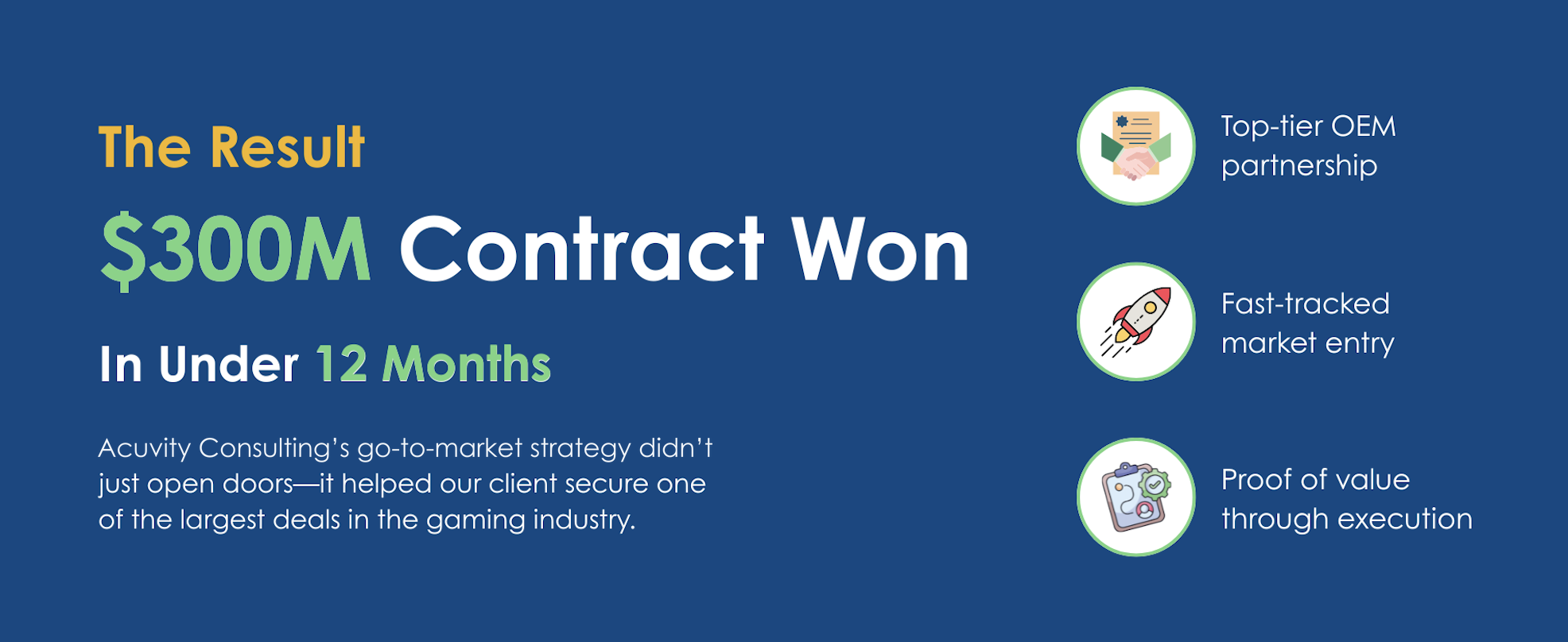
Our tailored strategy didn’t just make the client eligible for OEM conversations—it helped them close one of the largest deals in their vertical, a $300 million contract with a top gaming manufacturer.
Data-Driven Market Segmentation: TAM/SAM analysis connected growth areas with real client capability. Key performance indicators were used to track progress and measure the impact of the segmentation strategy.
OEM-Centric Messaging: Positioning was grounded in value chain gaps and component-level ROI.
Geographic Prioritization: Markets were prioritized based on regulatory complexity, growth velocity, and OEM saturation.
Cross-Functional Alignment: We helped unify product, operations, and sales teams around a common market entry playbook. As a result, the strategy contributed to increasing the client’s market share in the gaming industry.
Whether you’re entering regulated industries, evaluating new verticals, or struggling to scale with OEMs, Acuvity Consulting brings the tools, insight, and real-world experience to guide the way.
If your organization is exploring market expansion, vertical penetration, or OEM growth strategy, we can help you map the opportunity and act on it with confidence. When developing a go-to-market strategy, it is essential to plan for future customers by understanding their needs and expectations. Entering a new market presents unique challenges and opportunities, and a tailored approach is crucial to ensure your product or service resonates and succeeds.
📞 Schedule a discovery call with us:
https://calendly.com/venkatavasarala
🌐 Explore our services & case studies:
📩 Contact us:
Venkat Avasarala Sep 11, 2026

Venkat Avasarala Jun 25, 2026

Venkat Avasarala May 29, 2026