LET'S CHAT OVER COFFEE - CALL US @ (925) 315-5678



Most companies invest more in technology every year, yet results remain stubbornly elusive. The problem isn’t the technology. It’s the gap between where the boardroom points and where the tech stack actually goes.
There is a paradox sitting at the heart of most organizations today. Boards are authorizing record technology budgets. CIOs are deploying AI, cloud, and automation at pace. And yet, when you ask senior leaders whether their technology is actually serving their strategy, the honest answer — from most of them — is no.
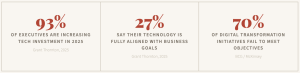
A 2025 survey by Grant Thornton of more than 550 executives across industries found that 93% of organizations are increasing technology investment this year, yet only 27% describe their technology as fully aligned with business goals. That is not a technology problem. That is a strategy problem, specifically, the failure to bridge what the organization wants to achieve with what its systems are actually built to do.
This is the alignment gap. And it is costing businesses far more than wasted software licenses.
The scale of misalignment is not abstract. Research from Boston Consulting Group and McKinsey consistently shows that 70% of digital transformation initiatives fail to meet their stated objectives. Bain’s 2024 analysis puts the figure even higher, finding that 88% of business transformations fall short of their original ambitions. A separate MIT study found that 95% of enterprise AI initiatives fail outright — while noting that the successful 5% share three traits: human enablement, strategic alignment, and disciplined execution.
Gartner, meanwhile, predicts that at least 30% of generative AI projects will be abandoned after the proof-of-concept stage by the end of 2025 — not because the technology doesn’t work, but because organizations couldn’t articulate a clear business case to justify scaling.
The common thread across all of these failures is not technological incompetence. It is the persistent disconnection between the business strategy defined in the boardroom and the technology decisions made on the floor below it.
Root Cause
Technology fails strategy not when it is poorly built, but when it is built for the wrong purpose — solving yesterday’s problems, optimizing processes that shouldn’t exist, or serving departmental goals that are disconnected from the enterprise’s direction of travel.
KPMG’s 2025 research on IT-business alignment identifies three structural reasons why this gap persists even in well-resourced organizations:
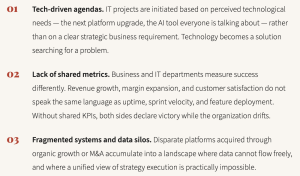
The Strategy Institute frames this as an execution gap, one that manifests when the organizational vision never translates into changed behavior, when internal tools are still running yesterday’s playbook, and when accountability is so diffuse that no one owns the outcome.
McKinsey’s research identifies organizational culture, not technology, as the single biggest obstacle to successful digital transformation. Organizations that invest in cultural change alongside technology adoption see 5.3 times higher success rates than those that focus on the tech stack alone.
This is a harder conversation for leadership to have. Buying a new platform is a clear decision with a clear price tag. Changing how people think about their work, how they collaborate across functions, and how they relate to new tools. That is slower, messier, and cannot be approved in a single budget cycle.
Yet it is precisely this investment that separates organizations that transform from those that merely spend. As one industry analysis put it bluntly: technology doesn’t fix what isn’t understood — it only accelerates what already exists. Automating a broken process produces a broken process, faster.
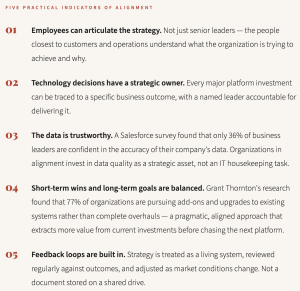
True alignment is not a project. It is a condition. The Strategy Institute describes it as the state in which every element of the organization — capabilities, processes, technologies, incentives — is traceable back to a strategic objective. It means employees at every level can explain how their daily work connects to the company’s direction. It means technology is selected because it enables the operating model, not because it is the newest option available.
Deloitte’s 2025 technology value research, drawing on longitudinal data across nearly 550 organizations, identifies leadership alignment as the single biggest unlock for digital value. When CFOs, CIOs, and CTOs define success differently, some measuring ROI, others EBITDA, others KPIs, value gets stranded across all three. Shared language and shared metrics are not soft benefits; they are the mechanism through which technology investments convert into business outcomes.
Globally, failed digital transformation efforts are estimated to cost organizations $2.3 trillion per year. That figure captures direct project costs, but not the harder-to-quantify losses: the competitive ground ceded while competitors execute, the talent drained by initiatives that go nowhere, and the erosion of confidence in leadership’s ability to navigate change.
The ClearPoint Strategy research puts the execution failure rate at 90%, nine in ten organizations that develop effective strategies fail to implement them. The cause is almost never a weak strategy. It is a systems problem: the absence of shared visibility, clear ownership, and a consistent rhythm of review and adaptation.
For leaders who recognize this gap in their own organizations, the path forward is less about new technology and more about new discipline. The Grant Thornton survey found that organizations driving growth in the current environment are doing three things consistently: centering technology decisions on customer needs rather than internal process improvement, unifying decision-making across silos through integrated data and live connectivity, and treating technology adoption as an ongoing organizational capability rather than a one-time project.
Gartner’s research with early AI adopters offers a useful benchmark: when organizations start with clear objectives rather than available tools, they report an average 15.8% increase in revenue, 15.2% in cost savings, and 22.6% in productivity improvements. Clarity of purpose, applied before technology selection, is not a soft precondition. It is the determining factor in whether the investment delivers at all.
The organizations that will lead their industries into the next decade are not necessarily the ones with the largest technology budgets. They are the ones that have done the harder work of ensuring every dollar of that budget is pointed in the same direction as their strategy, and that their people, processes, and culture are ready to make it land.
Technology alignment is not a one-time exercise completed at the beginning of a fiscal year. It is an ongoing organizational discipline — the consistent habit of asking, at every decision point: does this serve where we are going, or where we have been?
That question, asked honestly and often, is what separates strategy from aspiration.
—————————————————————————————————————————————————————————
Sources & References
Venkat Avasarala Sep 11, 2026

Venkat Avasarala Jun 25, 2026

Venkat Avasarala May 29, 2026
