LET'S CHAT OVER COFFEE - CALL US @ (925) 315-5678



When mid-market companies look for outside advisory support, the decision is rarely about choosing the biggest name.
More often, it is about choosing the right fit for the business, the challenge at hand, and the pace at which leadership needs to move.
Many mid-market firms are operating in an environment where growth, efficiency, and modernization all need to happen at the same time. That makes partner fit especially important.
Large consulting firms bring real strengths.
They offer scale, broad service lines, deep specialty benches, and experience supporting highly complex transformations across large organizations. For many companies, especially those managing multinational operations or enterprise-wide programs, that model can be the right one.
But for many mid-market companies, the ideal partner often looks different.
These organizations are often balancing growth, operational improvement, technology modernization, and tighter resource constraints at the same time. In that environment, leadership teams are not always looking for the largest consulting platform. They are looking for a partner that is practical, accessible, and closely aligned with the realities of the business.
That is one reason boutique consulting firms continue to resonate with the mid-market.
At Acuvity Consulting, we see this firsthand.
As a California-based boutique management consulting firm, we work with organizations that need focused, senior-level guidance without unnecessary complexity.
As a Big 4 alternative, our role is not to replicate the large-firm model on a smaller scale. It is to offer a different kind of partnership, one that bridges business strategy and technology strategy and is grounded in practical, executive-level problem solving.
As a minority-owned consulting firm serving healthcare, manufacturing, technology, and public sector clientshttps://acuvity.com/about-us/, we understand that different organizations require different advisory models, and that fit matters as much as capability.
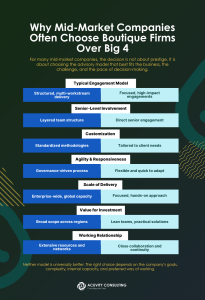
This is not a story of one model being better and the other being worse.
It is about understanding where each model tends to perform best.
Large firms often make sense when an organization needs broad geographic coverage, highly specialized capabilities across multiple domains, a large delivery team, or support for complex enterprise-wide programs.
Their scale can be especially valuable for multinational transformations, major ERP rollouts, highly regulated environments, or situations where a company wants one provider across many workstreams.
That scale can also bring highly structured methodologies, extensive research resources, and access to a broad network of specialists.
Boutique firms often stand out when a company wants closer senior-level involvement, a more tailored approach, greater flexibility, and advice that is closely tied to execution realities.
As Harvard Business Review notes in “Consulting Is More Than Giving Advice”, the value of consulting is not just analysis alone, but helping clients solve the right problem in a way that is relevant to their situation.
For mid-market companies, that distinction matters.
One of the biggest reasons mid-market leaders choose boutique firms is the level of senior attention they often receive during an engagement.
In many boutique models, the people shaping the strategy are also the people actively involved in the work. That creates a more direct, collaborative experience for leadership teams that want sharper discussions, faster decisions, and fewer handoffs.
This is not a criticism of larger firms, which often have strong teams and rigorous staffing models. It is simply a reflection of how boutique firms are typically structured.
Mid-market companies are rarely looking for a generic playbook.
They want recommendations that match their size, operating model, growth stage, and internal capacity.
Boutique firms often have an advantage here because they can build around the client’s specific context rather than applying a more standardized enterprise model. That kind of customization can be especially valuable when the business is evolving quickly or dealing with a unique mix of commercial, operational, and technology priorities.
For firms like Acuvity Consulting, that often means helping clients connect high-level strategic goals with the operational and technology decisions required to support them.
For mid-market companies, that bridge between strategy and execution is often where real progress happens. This aligns closely with the broader point made in Grant Thornton’s piece on building an operating model to grow with your business, which emphasizes that growth needs to be supported by the right people, processes, technology, and risk infrastructure.
Many mid-market companies value speed.
They do not always have the time, budget, or internal bandwidth for a prolonged consulting process.
Boutique firms are often built to be more agile. They can usually adapt more quickly when priorities change, refine the scope without unnecessary complexity, and work in a way that feels more integrated with leadership’s decision cycle.
This need for a scalable and sustainable operating model is also reflected in Grant Thornton’s growth strategy content, which highlights how organizations can struggle when growth outpaces the infrastructure built to support it.
Cost should never be the only decision factor, but it is always part of the equation.
Mid-market companies are usually thoughtful about where they place advisory dollars. They want expertise and impact, but they also want confidence that the engagement is built around outcomes rather than unnecessary complexity.
Boutique firms often offer a compelling value proposition because the work can be more focused, the teams can be leaner, and the recommendations are often designed to be practical and executable.
Mid-market leadership teams often want a partner that feels engaged, accessible, and genuinely invested in the outcome.
That is another area where boutique firms can stand out. Smaller teams often allow for more direct communication, stronger continuity, and a greater sense of partnership over the course of the engagement.
This is especially valuable when the work involves ambiguity, organizational alignment, or transformation efforts that require trust across the leadership team.
To make the decision well, companies should be honest about the trade-offs on both sides.
A larger consulting firm may offer broader scale, more formal infrastructure, and a larger bench of specialists, but that can sometimes come with more layers, a more standardized delivery model, or a higher-cost structure.
A boutique consulting firm may offer stronger personalization, faster response times, and more senior attention, but it may not be the right choice for a company that needs a massive global delivery engine or highly specialized support across many countries and functions at once.
Neither model is universally better.
The better model is the one that best matches the company’s priorities.
For many mid-market companies, the goal is not to hire the most famous consulting brand.
It is to find a partner that understands where the company is today and what it will realistically take to move forward.
That usually means looking for a firm that can bring senior-level judgment, tailor the work to the company’s stage and operating reality, move with speed when priorities shift, provide practical recommendations that leadership can act on, and connect business priorities with technology strategy where needed.
Those priorities often align naturally with the strengths of boutique consulting firms.
They also help explain why many organizations across healthcare, manufacturing, technology, and the public sector increasingly look beyond traditional large-firm models when selecting an advisory partner.
Acuvity’s own positioning reflects that intersection of strategic rigor and boutique agility.
Large firms continue to play an important role in the consulting market, and in many situations they are absolutely the right choice.
But for many mid-market companies, a boutique consulting firm can be a better fit.
Not because it is trying to be a smaller version of a global firm, but because it offers something different: a more hands-on model, closer senior involvement, greater flexibility, and advice shaped around the company’s actual context.
For organizations navigating growth, modernization, and change, that can be exactly what makes the difference.
At Acuvity Consulting, we believe the strongest advisory relationships are built on clarity, trust, and relevance to the client’s real business priorities. As a boutique management consulting firm headquartered in California and serving clients across the United States, and as a Big 4 alternative, we help clients bridge business strategy and technology strategy in ways that are practical, focused, and aligned with where they want to go next.

Venkat Avasarala Jun 25, 2026

Venkat Avasarala May 29, 2026

Venkat Avasarala Apr 24, 2026
