LET'S CHAT OVER COFFEE - CALL US @ (925) 315-5678



Growth has never been more complex.
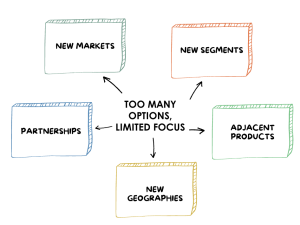
Executives today are staring at an overwhelming menu of options: new markets, new segments, adjacent offerings, new partners, new geographies. Each looks promising on its own. Collectively, they create paralysis.
The real constraint is not ambition. It is focus.
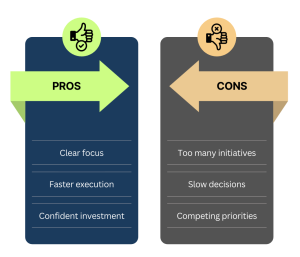
Most leadership teams are forced to place big bets with limited time, limited capital, and incomplete information. The result is a familiar pattern: too many initiatives launched, too few scaled, and even fewer that deliver sustained impact.
The challenge is not a lack of ideas. The challenge is choosing the right opportunities with confidence.
Many organizations still rely on approaches that were designed for a simpler era.
Common failure modes show up again and again:
These methods feel structured, but they often mask uncertainty rather than resolve it.
What gets lost is the connection between market insight and execution. Teams walk away with analysis, but no clear direction. Or worse, they commit to initiatives that sound logical in isolation but compete for the same resources internally.
In fast-moving markets, this is costly. Speed matters. Precision matters more.
High-performing organizations approach growth decisions differently. They do not start with solutions. They start with clarity.
At its core, effective market analysis answers four questions:
Answering these questions does not require perfection. It requires a disciplined, repeatable framework that connects insight to action, such as Market Navigator™.
A Simple, Practical Framework for Growth Decisions
The most effective GTM strategies follow a clear progression:
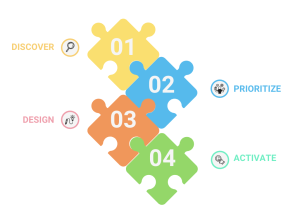
Start with a focused market scan. Understand customer needs, buying drivers, and how the value chain actually operates. Competitive mapping should reveal strengths, gaps, and unmet needs, not just names on a slide.
The goal is orientation, not exhaustiveness.
Not all segments are created equal. Use realistic market sizing and opportunity ranking to identify where effort will yield the highest return. This is where segmentation, ICP definition, and TAM, SAM, and SOM modeling must be grounded in data and practicality.
Prioritization is where strategy becomes real.
Once priorities are clear, define how to win. This includes GTM channels, value messaging, positioning, and partner strategy. Design choices should reflect market reality, not internal preferences.
A good design phase makes execution easier, not harder.
Finally, translate insight into an executable roadmap. Clear milestones, ownership, and sequencing over the next 12 to 18 months turn strategy into momentum.
Execution is not an afterthought. It is the point.
This progression creates focus without slowing teams down. It replaces guesswork with informed judgment and aligns leadership around a shared view of where to invest.
When market analysis and GTM strategy are done right, the impact is tangible:
In an environment where resources are constrained and expectations are high, clarity becomes a competitive advantage.
Growth does not come from chasing every opportunity. It comes from choosing the right ones and executing with discipline.
That is the shift from chaos to clarity. And it is the foundation of confident, sustainable growth.
Market Navigator™ was built to enable exactly this outcome. It helps leadership teams cut through market noise, identify where real opportunity exists, and translate insight into an execution-ready roadmap. Rather than analyzing everything, the focus stays on what matters most now, and what should come next.
If your organization is evaluating growth options and needs a clearer, more confident path forward, Market Navigator™ provides a structured way to move from complexity to clarity.
👉 Explore Market Navigator™ or schedule a diagnostic conversation to determine your highest-priority growth opportunities.**

Venkat Avasarala Mar 20, 2026

Venkat Avasarala Feb 26, 2026

Venkat Avasarala Dec 26, 2025
