AI adoption in 2026 is reshaping enterprise strategy at a pace unmatched by previous technology waves. Organizations are no longer simply choosing tools. They are managing workforce disruption, navigating governance and risk, and rethinking how value is created. AI’s impact goes beyond productivity gains: it is driving structural shifts in jobs, skill requirements, compliance expectations, and ethical accountability.
This blog cuts through the noise. It clarifies today’s AI landscape, surfaces real-world use cases, outlines emerging risks, and introduces how AI Compass helps organizations align innovation with business strategy and responsible governance.
Understanding the AI Landscape
The AI ecosystem in 2026 is broader and more complex than ever. What began as traditional machine learning has evolved into a multi-layered environment of foundation models, multimodal tools, agentic systems, and domain-specific AI. As organizations scale adoption, governance, risk management, and responsible use are moving to the center of enterprise strategy.
AI capabilities can be understood through a simple hierarchy:
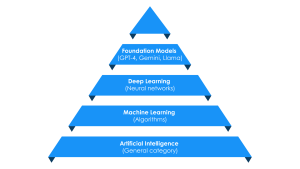
- Artificial Intelligence — Systems that mimic cognitive functions like reasoning and perception.
- Machine Learning — Algorithms that learn and improve from data.
- Deep Learning — Neural networks that process unstructured inputs like text, audio, or images.
- Foundation Models — Large, versatile models trained on massive datasets and adaptable to many tasks (e.g., GPT-4, Gemini, Llama).
(Source: Stanford AI Index 2025)
Where today’s models fit
- General-purpose LLMs: GPT-4, Claude, Llama
- Multimodal & Coding AI: Gemini, Copilot, Tabnine, Perplexity
- Efficient / Open Models: Mistral, Mixtral
- Enterprise-grade Models: Cohere and other privacy-first systems
Choosing the right model depends on the problem, data sensitivity, integration needs, governance requirements, and total cost of ownership, not the model’s popularity.
Practical Use Cases Across Industries
AI is already delivering measurable business outcomes across sectors:
Healthcare
- Mayo Clinic: GPT-4-driven clinical documentation reduced paperwork time by 40% and increased patient throughput. (McKinsey)
- Babylon Health: AI chatbots handled 3M+ consultations annually, cutting wait times by 30%. (McKinsey)
Finance & Banking
- JPMorgan COIN: Automated contract review saved 360,000 staff hours per year. (NineTwoThree)
- HSBC: AI-powered AML monitoring reduced false positives by 60%. (McKinsey)
Manufacturing & Logistics
- BMW: Predictive maintenance cut outages by 25% and saved $12M annually. (247Labs)
- Walmart: AI-driven supply chain optimization saved hundreds of millions in fuel and routing efficiencies. (McKinsey)
Retail & CX
- CarMax: AI-enhanced search increased engagement by 20%. (NineTwoThree)
- Target: Inventory AI reduced stockouts and excess levels across a $15B supply chain. (Second Talent)
Education
- Khan Academy: GPT-4 tutoring system delivers personalized STEM learning. (Google Cloud)
- Duolingo: AI-driven simulations boost retention and engagement. (NineTwoThree)
Legal, Energy & Beyond
- BakerHostetler: AI research tools reduced legal review time by 70%. (NineTwoThree)
- Shell: Predictive AI for wells and energy forecasting saved tens of millions. (McKinsey)
Consequences of AI Adoption in Real Life
Layoffs & Workforce Shifts
AI-driven restructuring is increasingly visible:
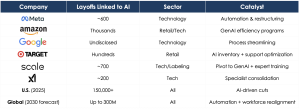
(Source: Business Insider, Bloomberg, CNBC, etc.)
These shifts signal not just job loss, but a redefinition of work, with new roles emerging faster than old ones disappear.
Navigating Obstacles and the Opportunity Ahead
Why AI Projects Fail
More than 75% of enterprise AI projects fail to deliver expected ROI.
Common causes include:
- Poor data quality and fragmented data silos
- Weak governance and unclear ownership
- Limited enterprise-wide AI literacy
- Lack of measurable KPIs or business alignment
- Overdependence on a few specialists
- Pilots that never scale
How to Remedy These Gaps
- Perform a comprehensive AI Maturity Assessment covering strategy, data readiness, infrastructure, and governance.
- Prioritize small, high-impact pilots tied to measurable KPIs.
- Build cross-functional teams and embed AI training into culture.
- Establish transparent reporting, communication cadences, and stakeholder alignment.
Ethical & Environmental Risks
AI introduces risks that leaders must actively manage:
- Bias: Flawed or unrepresentative data can lead to discriminatory decisions in lending, hiring, healthcare, and insurance.
- Privacy: Sensitive data, especially in regulated industries, requires strict handling.
- Environmental impact: Large model training increases compute and carbon footprint.
Mitigation Strategies
- Use bias detection tools like Fairlearn or IBM Fairness 360.
- Establish an internal AI Ethics Board for high-stakes deployments.
- Track and minimize AI carbon emissions through efficient hardware and green compute practices.
Governance, Regulation & Closing the Gaps
Regulatory Compliance Requirements
Organizations must align with GDPR, CCPA, HIPAA, ISO/IEC AI standards, and industry-specific mandates. Non-compliance risks fines, lost market access, and operational disruption.
Best Practices for Governance
- Documented guidelines: Clear policies for acceptable use, data rights, and explainability.
- Regular audits: Quarterly reviews of models, data flows, and logs.
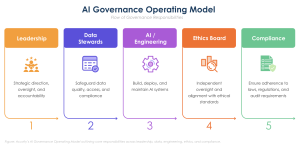
- Role-based protocols: Clear responsibilities for AI leaders, data stewards, and ethics officers.
- Transparency & accountability: Live dashboards, incident reporting, and stakeholder feedback loops.
- Ethics board oversight: Authority to approve, pause, or retire high-risk systems.
- Sector-tailored compliance:
- Finance: AML/KYC monitoring, bias-free lending, audit trails
- Healthcare: HIPAA controls, explainability for clinicians
- SaaS: Consent flows, explainable models, ISO certifications
How to Choose the Right AI Solution
Key criteria include:
- Business alignment: Clear problem definition and measurable KPIs
- Security & consent: Encryption, access controls, privacy compliance
- Integration: Open APIs and modular architecture
- Retrieval & explainability: Transparent models and auditable logs
- Cost & scale: Balance between TCO, deployment speed, and long-term scalability
- Ongoing governance: Drift detection, anomaly monitoring, and escalation protocols
Charting a Strategic Path Forward with AI Compass
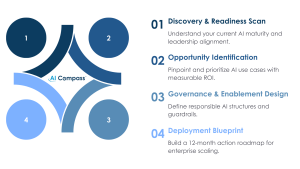
AI Compass provides a structured, responsible approach to enterprise AI transformation:
- Discovery & Readiness
Maturity assessments, data/tech audits, skills mapping, and leadership alignment.
- Opportunity Identification
Prioritized use cases with quantified impact, risk scoring, and complexity assessment.
- Governance & Deployment
Co-created policies, privacy and ethics controls, auditability, and compliant pilot design.
- Blueprint & Continuous Innovation
Scale successful pilots, implement ongoing monitoring, and refresh strategy as technology and regulations evolve.
The result: Organizations move from scattered experimentation to a well-governed, business-integrated AI operating model, delivering strategic value, ethical confidence, and sustained innovation.
Conclusion
AI in 2025 is redefining work, reshaping industries, and raising the bar for responsible leadership. Success requires more than adopting tools. It demands strategic clarity, strong governance, workforce readiness, and a structured approach to scaling.
If your organization is navigating these shifts, AI Compass can help you move from experimentation to enterprise-wide impact.